The Woman Who Set Fire to Heaven
Burning away the reward and the threat. What remains is what you actually love.
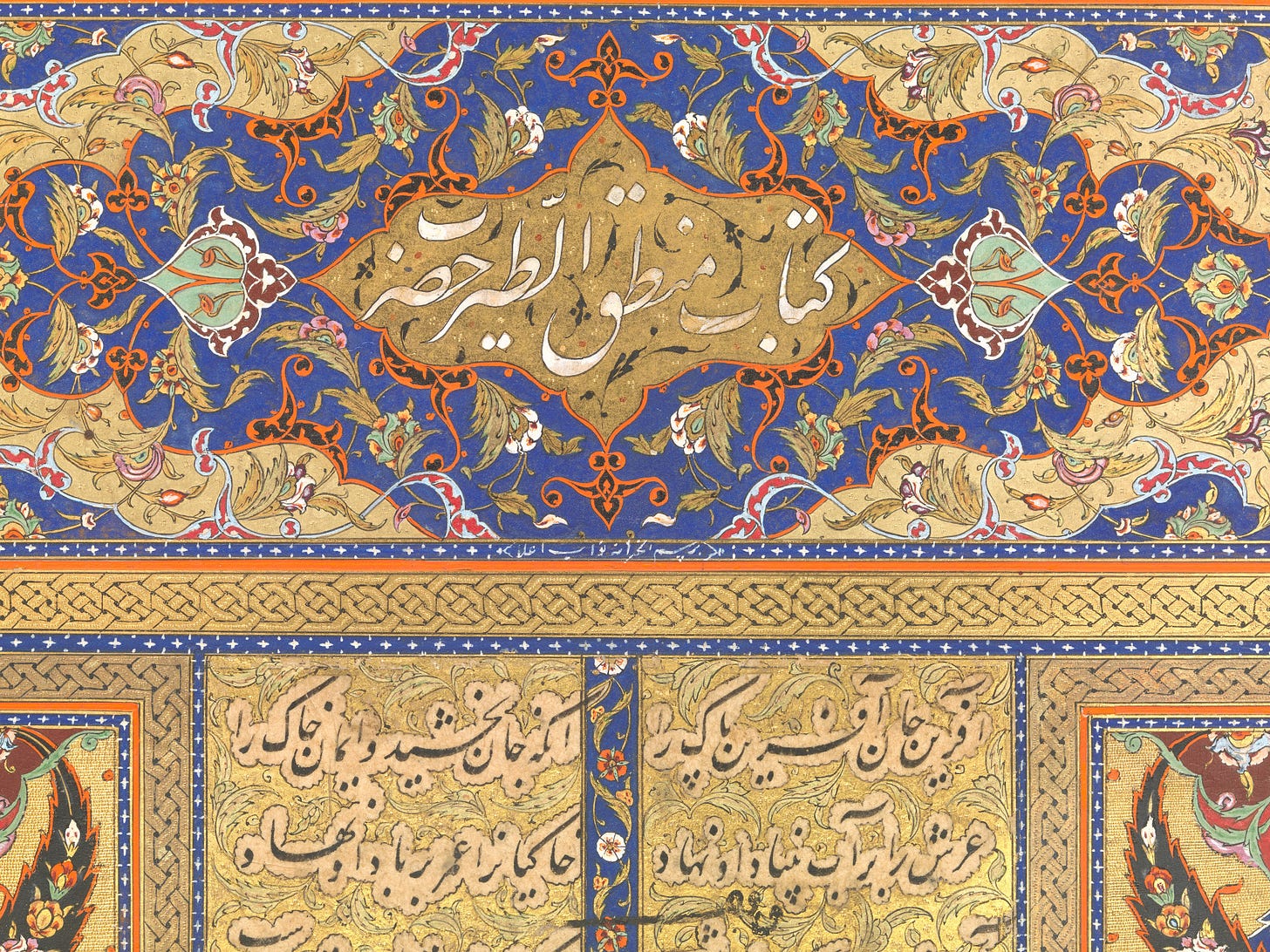
Someone stops a woman running through the streets of Basra with fire in one hand and water in the other. Where are you going, Rabiʿa? To set heaven ablaze, she says, and pour water on hell — so that both veils fall, and people stop loving God for the reward, and stop obeying out of fear of the flames. So that what remains is love, free and clear.1
To understand what that means, you have to see where she was standing.
The city
You come up from the harbor in Basra, around the year 800. You smell it before you see it — salt off the marsh, camel dung in the lanes, pepper just landed from India and the East African coast. Date palms rise above the narrow streets. Half the streets are water: canals run right up to the doorsteps. Behind you the boats keep unloading, and the air is loud with a dozen languages.
Basra was founded as a desert military outpost just years after the Prophet Muhammad died. In barely two centuries it swelled into a city. Islam never arrived here; the city was Muslim from its first tent. Ships come daily now. Merchants grow fat on the trade while enslaved East Africans are worked until they break. Nobody hides this; slavery is legal, ordinary, the accepted base the city stands on.
And because the faith is barely older than the streets, almost nothing about it is settled. On the corners people argue whether a sinner is still a believer or already damned, whether your acts are your own or God’s decree, whether the Qurʾan is eternal or made — the kind of arguing that, here in Basra, is hardening into the Muʿtazila, Islam’s first school of reason. The grammarians fight too, over the exact vowels of the revealed text, because to mis-read it is to mishear God.
Sold and freed
Into that came Rabiʿa al-ʿAdawiyya. The stories about her, written centuries later by the hagiographer ʿAttar, describe her as the fourth daughter of a family so poor there was no oil for a lamp the night she was born. Her name just means the fourth. Orphaned young and caught in a famine, she was seized and sold into slavery as a child for a handful of coins. She spent her early life as a thing with a price.
How she got free, the tradition tells as a miracle: her master woke one night to a lamp burning in the air above her head as she prayed, lit by no hand. He understood then that he had been keeping a holy woman as a slave, and at dawn he set her free.
As a freed woman, she refused every offer of marriage — the governor’s included — to belong to no one but God. All she owned was a reed mat, a cracked jug, and a brick she slept on for a pillow. She fasted and prayed at night.
What she wanted
In her lifetime there was no “Sufism” yet — only ascetics fleeing the world into prayer. The name, and the tradition, came later: Sufism, the mystical heart of Islam, the path that wants to know God directly, not only obey him.2 Rabiʿa stands at its source. Rumi and Hafiz — the Sufi poets most readers know — come nearly five centuries downstream of her, and she was among the first to insist that the soul and God are in a love affair — the very thing they’re famous for. In her day, devotion ran on fear and reward together — the fire below, the garden above. She said it could run on love instead: love for God alone, not for anything He might hand out.
That’s the message she carried to the streets: a torch in one hand, a bucket of water in the other.
Love for nothing
In Arabic the worshipper is the ʿabd3 — the slave of God; even the word for worship, ʿibada, grows from the root for slavery. The faith framed every believer as God’s servant, working for the wage of paradise and flinching from the lash of hell. Rabiʿa had been an actual slave — bought, sold, owned — and she knew that arrangement in her body. The theologians arguing on the corners about who God will reward and who God will burn were only keeping a master’s ledger. She refused to meet God across that counter. If she was going to be God’s, it would be as a lover, not a servant working off a debt.
She did it by subtraction. Burn the heaven, and there is no reward left to love God for. Douse the hell, and there is no fire left to fear Him by. Strip both away, and the devotion that remains has nothing to gain and nothing to dodge. It is just that: devotion.
And that devotion was total — it wanted all of her — and a devotion that size cannot share the house. A life full of the ordinary furniture — a husband, a household, possessions, and even the holy wants, the hope of paradise, the fear of the fire — leaves it no room. The profane crowds out the sacred; the Beloved (the Sufi name for God) cannot move into a furnished room.
So she kept her life empty, so the one thing she wanted could fill it. What she wanted was not less. It was room for the Beloved.
And this was no small act. The ledger she walked away from was the theological machine that ran the whole Muslim world — the reward-and-punishment economy the jurists codified, the grammarians in the square defended, and every learned man took for granted as the shape of faith itself. She looked at the oldest and holiest incentive system there is and set it on fire.
Here was a woman — a freed slave, with no schooling anyone had credentialed and no standing in any of it — refusing the terms outright.
Now
So turn it on yourself. Think of what you love most. Perhaps it's God, as it was for Rabiʿa — or something more of this world: a person, an animal, a cause, a passion project, the natural world. Ask it two things. First: does it have room in your life, or has it been crowded out by everything else you've let fill the space? And then the harder one: is the love for the thing itself — for the doing of it, the being-with-it — and not for what it gives back?
Picture the praise and the pride stripped away, and the guilt and the fear of judgment gone too. What would be left of the love?
That was her question too — the one she ran through Basra to ask, fire in one hand and water in the other. She answered it with her life. Her answer is in the prayer remembered as hers4:
O God — if I worship You in fear of hell, burn me in hell. If I worship You in hope of paradise, shut me out of paradise. But if I worship You for Yourself alone, do not withhold from me Your everlasting beauty.
Burn the heaven you were promised. Pour out the hell you were threatened with. Whatever is still standing when both have gone out — that is the thing you actually loved.
Rabiʿa al-ʿAdawiyya (c. 717–801 CE), of Basra, in what is now southern Iraq. The biographical scenes — the fourth-daughter birth, the famine and the sale into slavery, the refused marriages, the torch and the bucket, and the prayer below — come from later Sufi hagiography, chiefly Farīd al-Dīn ʿAttar's Tadhkirat al-Awliyāʾ (Memorial of the Saints), written roughly four centuries after her. They are the tradition's telling, not documented biography; modern scholarship questions much of the received life (see Recontextualising Rabiʿa and Dhū'l-Nūn). What is historically firm: she was an early, very poor female ascetic of Basra, remembered for turning devotion toward divine love (ḥubb / maḥabba).
Sufism (taṣawwuf) — the mystical tradition within Islam; not a sect but an inward path pursued across Sunni and Shia Islam alike. Rabiʿa is counted among its earliest and most revered figures, and among the first to make love (rather than fear of judgment) the center of the path.
The worshipper as ʿabd — in Arabic ʿabd (عبد) means slave or servant, and is the ordinary word for a worshipper of God (as in ʿAbdullāh, "servant of God"); ʿibāda (عبادة), "worship," grows from the same root, ʿ-b-d. The servant-of-God framing is built into the very vocabulary of Islamic devotion.
The prayer — a saying traditionally attributed to Rabiʿa; recorded in al-Ghazali's Iḥyāʾ ʿUlūm al-Dīn (d. 1111) and in ʿAttar's Tadhkirat al-Awliyāʾ (d. ~1221), and given its familiar English form by Margaret Smith, Rabiʿa the Mystic (1928). The wording varies across sources — pin the version you publish to one named translation.