The Length of a Road
Francis of Assisi gave away everything he owned. What he was really giving up was distance.
Most people know Francis of Assisi as the saint in the garden statue: brown robe, a bird on his outstretched hand, patron of animals and one of the best-loved saints in the world. He is the great emblem of holy poverty: a man who gave away everything he had to live simply, close to God and the poor. We picture him, in short, as a man who wanted less. But for the first twenty-five years of his life he wanted exactly what his city wanted: more.
He was, to put it plainly, a rich kid. His father, Pietro Bernardone, was a cloth merchant in Assisi — a hill town in central Italy — and at the turn of the thirteenth century cloth merchants were the new rich. This was the beginning of the age when money came less from owning land than from trade. And Pietro traded. He didn’t raise the sheep or dye the wool; he bought finished cloth, much of it French, carrying it back over the Alps from the great cloth fairs of Champagne, and sold it at home for more than he paid. The family was new money, and they had a lot of it.
They had the boy baptized Giovanni, but everyone called him Francesco — “the little Frenchman” — for his father’s French trade and the troubadour songs he sang in the streets, songs about knights and the glory a young man could win.
Because glory was the point, and it was Francis’s own: not only his father’s ambition for him, but the very thing his troubadour songs had promised. The one prize a merchant’s money still couldn’t buy was rank: knighthood, the old nobility the land-owning families kept to themselves. But a young man could earn it in war.
So in 1202, when Assisi fought the neighbouring city of Perugia, Francis rode out to win it, in armour his father’s cloth had paid for. Assisi lost. He was captured, spent close to a year in a Perugian prison, and came home sick, and quieter. But he still wanted it, enough to try once more: a few years later he set out again, for a war in the south, certain this was the road to knighthood at last. He got a day from home, to Spoleto, and turned around. The accounts give him a dream that night: a voice asking why he would ride so far to serve a man when he might serve God.
Whatever it was, he came home from a war he had left home certain about, and the climb to nobility he had wanted his whole life had quietly stopped looking like it led anywhere.
In the months that followed he was half-lost: praying alone, giving his money away, keeping to himself. And somewhere in that stretch, on a different road below the town, he met a leper.
He heard the leper before he saw him: the knock of a wooden clapper up the road. Lepers were made to carry one and sound it as they walked, to warn the healthy in time to get off the road. Leprosy was the terror of the medieval world, a disease that ate the hands and the face, and the law treated the people who had it as the already-dead: put out of the towns into lazar-houses, dressed in marked cloth.
That knock was the sound of a rule so old that no one had to be taught it: the clean did not touch the unclean, and between the two ran a space that no one crossed. It did what a siren does: you hear it, and you steer clear. Francis had spent his whole life on the safe side of that space.
He got down instead, walked across the road, and kissed the leper's hand. Later, he wrote: “what had seemed bitter to me was turned into sweetness of soul and body.”1
In that moment he was stepping into the oldest gesture of the Gospels: a leper approaches, the crowd draws back, and Christ — alone — reaches out and touches him, unafraid of the contagion or the shame. This was the scandal at the heart of Francis's whole religion: God himself, come down into a body, crossing the one distance the world swore could not be crossed, to take the hand of the person everyone else had cast out.
Francis was doing the thing every believer revered, and the thing almost none of them had ever actually done. Everything that came after unfolded from that road — and we usually get the order backwards. The renunciation did not come first. The closeness did: he crossed to the leper, and everything he gave away afterward was that same crossing, made again. The clothes he would hand back, the money he would not touch, the roof he would sleep without — none of it was ever really about the things. Each was another distance his world had built for him. Each he refused. The leper had simply been the first.
This is the point where his story stops being a medieval curiosity and turns uncomfortably close to home. Wealth is an arrangement of distances: from the sick, the poor, the cold, from anyone whose need might otherwise reach us. It might not feel that way. Instead, we might feel comfort, safety, choice. But comfort is precisely that: a measure of how far you can keep the world at arm’s length.
Seven centuries later Simone Weil would name the thing on the far side of all that distance in a single line: “attention is the rarest and purest form of generosity.”2 That is what his poverty actually was — the clearing-away of everything that stood between him and whatever was in front of him. Kissing the leper’s hand.
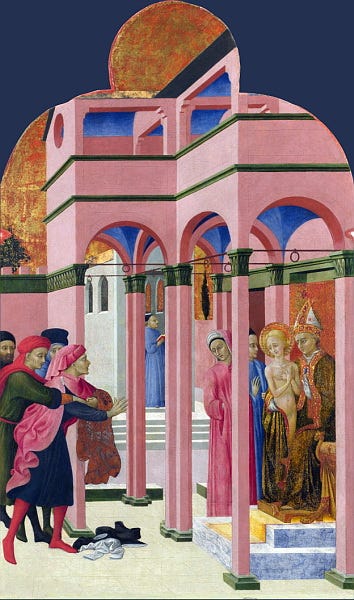
His father did not take it well. Francis had begun giving the family’s money away. He had even sold a bale of Pietro’s cloth, and his horse, to pay for repairs to a ruined chapel. Pietro was furious. He hauled his son before Guido, the bishop of Assisi, and demanded that Francis renounce his inheritance and give the money back.
It became the most public moment of his life. The square filled. The bishop took his seat in his robes; Pietro stood flushed and righteous, the town crowding in behind him to watch a rich man's son brought to heel. Francis was told to give the money back, and he did. But then he did something no one had asked for: he stripped.
He took off every piece of the fine clothes he was wearing, those too bought with his father’s money. He folded the clothes into a neat pile, laid them at Pietro's feet, and stood naked in the open square. "Until today," he said, "I have called you my father on earth. From now I can say only: Our Father, who art in heaven."
The bishop rose and covered him with his own cloak, and Francis walked out with nothing but that.
The life that followed was not a smaller version of the old one. It was the old one with the walls knocked out. He begged his bread, slept in the open, nursed the people no one else would go near.
Others came to join him — a handful at first, then hundreds — and they formed a brotherhood. He named them the Friars Minor — in Latin, the Ordo Fratrum Minorum, 'the lesser brothers' — and he meant it: to be low, small, beneath was the whole idea. They were cold and often hungry, and yet they sang. Francis called them joculatores Dei, the jesters of God, the Lord’s own troubadours: the boy who had grown up singing of knights and glory now stood at the head of a ragged, joyful company, singing for a different master entirely. That was the part that unsettled people — the joy did not come in spite of the nothing. It seemed to come from it.
And more than twenty years on — nearly blind, in near-constant pain, owning by then genuinely nothing — Francis wrote one of the first poems written in Italian rather than Latin, and it goes, in part:
Praised be You, my Lord, with all Your creatures, and first of all Brother Sun, who brings the day… Praised be You, my Lord, through Sister Moon and the stars… through Brother Wind, and through Sister Water… through our Sister Mother Earth, who feeds and keeps us… and through our Sister Bodily Death, from whom no one living can escape.3
A blind, dying, penniless man, calling the sun his brother, the moon his sister, and even death a member of the family. This is where the saint of the garden statue comes from, the one at peace with everything alive.
It is easy to read as a gentle love of nature. It is something harder than that. All his life he had refused the distance between himself and the other: the leper, the poor, the cast-out. And the other, it turned out, did not stop at the edge of the human. The animals, the water, the earth, the sun had been kept at a remove too, treated as lesser, as things to use. Owning nothing now, with no line left between what was his and what was not, he could meet them only as he had met the leper: as kin. The distance he'd first crossed on that road had gone on widening until it took in everything there was. He died the next year, already on kissing terms with the world.
Where this came from:
Francis’s life is told here as the tradition tells it — the early biographies of Thomas of Celano and Bonaventure, and The Little Flowers of St. Francis; his own words survive in his Testament, where he dates his whole conversion from the lepers — they are the first thing he records; the closing song is his Canticle of the Creatures (c. 1224–25), among the earliest poems in the Italian vernacular. The Gospel scene he steps into — Jesus reaching out to touch the leper — is Mark 1:40–45. For the sober history beneath the legends, Augustine Thompson’s Francis of Assisi: A New Biography (Cornell, 2012).
Francis of Assisi, Testament (1226), opening lines — trans. Regis J. Armstrong, J. A. Wayne Hellmann & William J. Short, Francis of Assisi: Early Documents, vol. 1 (New City Press, 1999). (The road-and-kiss scene is Celano's telling; the Testament itself records only Francis's mercy to the lepers and the "bitter → sweetness.")
Simone Weil, letter to Joë Bousquet (1942), in Simone Weil: Seventy Letters, trans. Richard Rees (Oxford University Press, 1965).
Francis of Assisi, Canticle of the Creatures (c. 1225), here abridged. Its imagery gives the 1972 Franco Zeffirelli film Brother Sun, Sister Moon its title; the film's songs, by Donovan, are modern works inspired by the poem, not the poem itself.