The Man Who Threw Away His Cup
Diogenes wanted less for the fiercest reason of all — freedom. And the word for what he was got reassigned to its opposite.
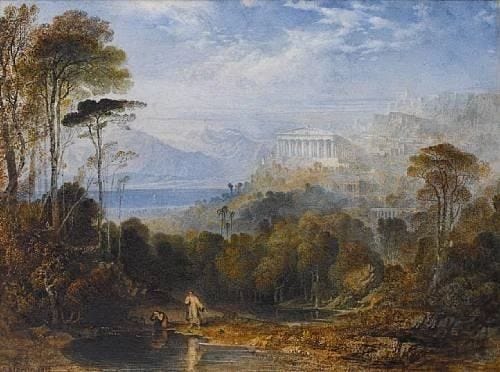
A child cups his hands at the fountain and drinks. An old man in a filthy cloak watches, then reaches into his bag, takes out his one wooden cup — his last object with a function — and lets it fall. “A child has beaten me in plainness of living.”1
This is Diogenes of Sinope, and the tradition tells him to us in pictures because the pictures are the argument. Exiled from his city over a scandal with defaced coinage — whether his own doing or his father’s, a banker at the Sinope mint, the sources can’t agree2— he arrived in Athens with nothing and decided nothing was the point. He lived in the marketplace inside a large ceramic storage jar — a pithos,3 the kind you’d keep grain in, not a barrel; the barrel is a later embroidery. He had a cloak, a staff, a bag for bread. The cup went the day a child humbled him.
He was the founder-figure of the Cynics, who held that virtue was the only good and everything else — money, status, comfort, the objects we carry — a cage. The tradition names him second in a lineage (Socrates → Antisthenes → Diogenes),4 though scholars debate whether that bridge is solid. What matters is what he did with it: he lived the philosophy as performance, not argument. No surviving texts. The life itself was the teaching. The jar in the agora was not a withdrawal from the world; it was a theater. He was always on display.
The logic
Want less. The instruction is plain, and Diogenes is not the only one who gives it. But his reason is his own. The ascetic wants less for holiness; the Buddhist, to loosen the grip of attachment; the Stoic, to fortify virtue. Diogenes wants less for something fiercer: freedom.
The Greek word is autarkeia — self-sufficiency, the state of needing nothing from outside yourself. The logic is brutal and runs one direction only: anything you need, anyone who controls it controls you. The cup can be stolen, lost, broken, begged for. The cupped hands cannot. Every possession audited down to nothing is one less handle by which the world can pick you up and move you. This is not philosophy as comfort. It is philosophy as extraction — pulling the teeth from the world’s bite.
When Alexander the Great stood over the pithos and offered him anything in the world, Diogenes asked him to step out of his sunlight.5 The most powerful man alive had nothing to bargain with: he could grant anything except the one thing Diogenes wanted — to be left in the sun — and he could not withhold it, because Diogenes needed nothing else. This is what kosmopolitēs, citizen of the world6, actually means. Not that you belong everywhere. That you belong to no master, because you own nothing anyone can threaten.
The mechanism
His method was not solitude. It was public provocation. He carried a lit lamp through the daytime crowds, saying he was looking for an honest man and not finding one.7 He performed his asceticism in the marketplace, where everyone could see — shaming the conventions by out-simplifying them, and letting onlookers draw the lesson.
The word the tradition puts at the root of both his exile and his philosophy is parakharattein — to deface the currency.8 And the Greek nomisma means a coin and a custom at once. So “deface the currency” became “deface the conventions”: mark them counterfeit, refuse their value. The refusal was not an escape from the world. It was the slowest, most deliberate confrontation with it possible.
The audit
Now run it on yourself — but not on your closet. That’s too easy, and it makes the Cynic a decluttering coach, which he was not.
Run it on the things you can’t afford to lose, which are mostly not things at all — and notice that each is also a thing you can no longer do. The good opinion you need: so you can’t afford to be honest. The standard you’re proud of: so you can’t be a beginner — the bar that looks like excellence is also a fence. Being needed: so you can’t stop, and can’t quite let them stop needing you. The thing that looks good on paper — the house, the title: it holds a mortgage on your attention, and the more you keep, the more of your life goes to the keeping.
That’s the Cynic’s real question — not Do I want this? (that’s consumer philosophy) but What does needing this stop me from doing? The teacher who can’t fail the student who adores her. The nurse who can’t refuse the shift that makes the rent, so the hospital works her past what’s safe and she thanks it for the overtime. The contractor who eats the scope-creep and the 11 p.m. email because losing the client means losing the month. Each of them needs something — and the need is the handle. The moment you need it, the world has a place to hold you, and a quiet list of things you’ll stop doing to keep its grip from tightening.
You’re not being told to throw it in the street. You’re being shown the exact shape of your own leash — where it attaches, and whose hand holds the other end. That clarity is the freedom. Diogenes just lived all the way inside it, and put the living on display.
The word inverted
He left no doctrine, no school — only the performance. The philosophical system came later: Diogenes taught Crates, Crates taught Zeno, who turned the insight into Stoicism around 300 BCE — a built thing, with a logic and a physics and an ethic. Today’s Stoicism revival is downstream of the man in the jar; but the jar is gone. We’ve forgotten the part where Diogenes lived his idealism out loud, was willing to look ridiculous, to be dismissed, to sit in a jar in the marketplace.
And somewhere between Diogenes and now, the word cynic inverted into its opposite. The ancient Cynic was a radical idealist about virtue and freedom. The modern cynic is a jaded pessimist who sneers at ideals. One is a yes that sounds like a no; the other a no that hides behind intelligence.
The Cynic’s freedom was never freedom from hope. It was freedom from leverage. He believed in virtue absolutely, and everything else was negotiable — a faith fierce enough to make him refuse a king. That is not cynicism. That is its opposite. That is faith enacted as performance.
Now
You don’t have to live in a jar. You don’t have to humiliate convention. But you can notice, just once, where the leverage is — where the world has you by a handle you didn’t know you’d given it permission to hold.
Diogenes made the choice visible, throwing away his last cup because a child had beaten him in plainness of living, and called himself a citizen of the world. What he meant was: I am owned by nothing. Not by pride, not by comfort, not by the approval of the most powerful man alive.
The sun was enough.
The cup, and “a child has beaten me in plainness of living” — Diog. Laërt. 6.37.
The defaced coinage and the exile — Diog. Laërt. 6.20–21. The sources disagree on whether Diogenes, his father Hicesias (a mint-official at Sinope), or both, debased the currency; the Delphic oracle’s “deface the currency” is the legendary hinge.
The pithos — a large storage jar, not a “barrel” (an early-modern mistranslation; barrels postdate him) — Diog. Laërt. 6.23.
The lineage Socrates → Antisthenes → Diogenes — Diog. Laërt. Book 6; some moderns doubt the Antisthenes–Diogenes link as biography. The forward chain Diogenes → Crates → Zeno (founder of Stoicism) — Book 7.
Alexander and “stand out of my sunlight” — Diog. Laërt. 6.38; also Plutarch, Life of Alexander 14.
kosmopolitēs, “citizen of the world” — Diog. Laërt. 6.63.
The lamp, “looking for an honest man” (literally a man, anthrōpos) — Diog. Laërt. 6.41.
parakharattein to nomisma — Diog. Laërt. 6.20–21, 6.71; nomisma means both “coinage” and “custom/convention” — the pun the whole philosophy turns on.