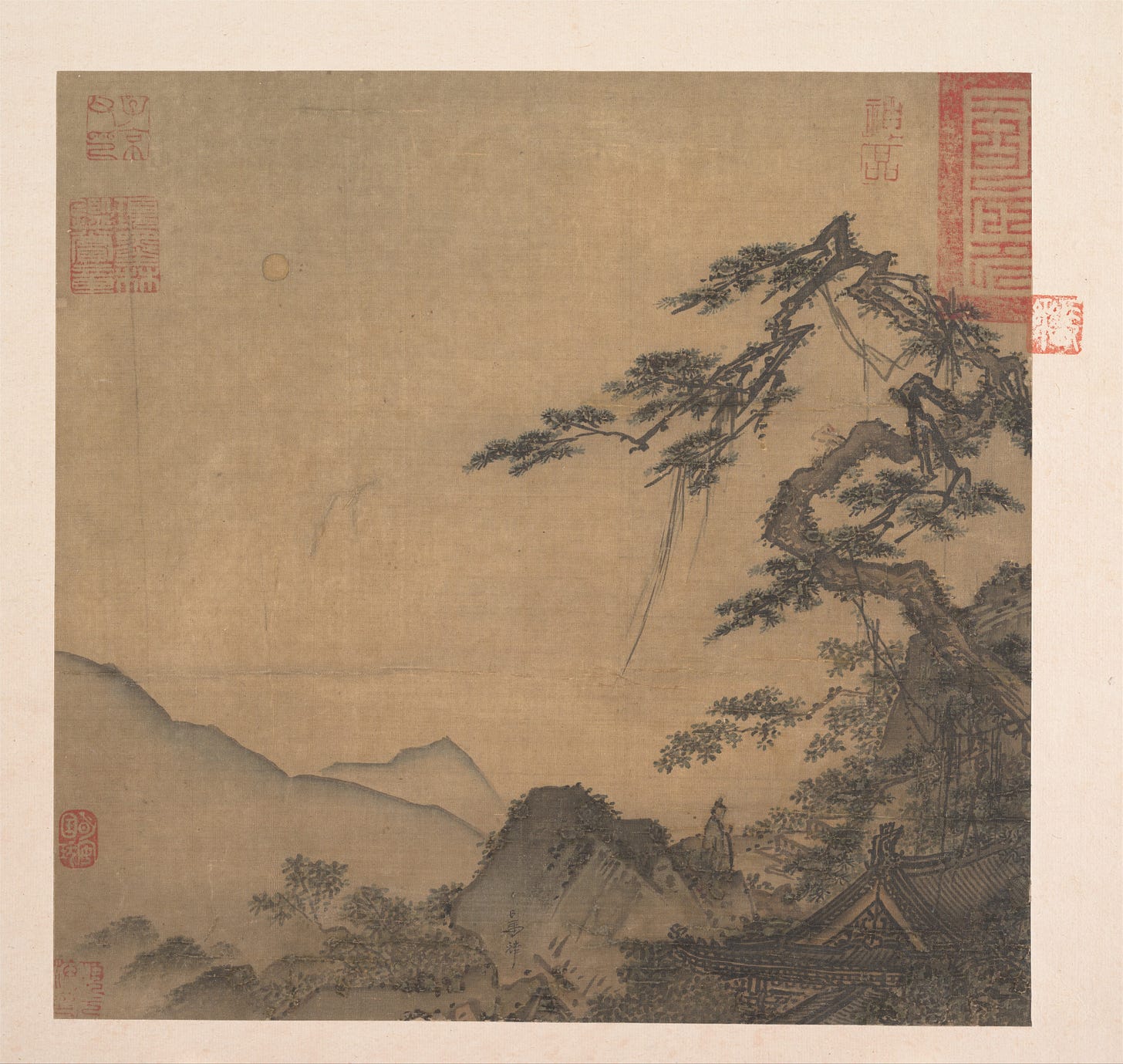
The Useless Tree
The Daoist wanted less — but not for freedom. For the shape you were before anyone carved you.
A parable to consider, not a prescription. How much of yourself are you willing to give away, and what might you be giving up in the process?
Around 369 BCE, in a small state in what would become China, a man named Zhuang Zhou sat at a river with a fishing line.1 He was not wealthy. He was not poor in the dramatic sense—he had eaten that morning, his clothes were worn but held. He was the kind of man a kingdom forgets about: minor posts, no reputation.
Then the envoys came.
Soldiers in formation, the visual weight of authority, the dust from hard riding.
Zhuang Zhou would have heard them coming, seen the horses, understood what it meant. A king had decided to want something from him.
What the king wanted was simple: you, in high office. Running the state.
Zhuang Zhou sat with the fishing line in his hand, watching the current. The moment stretched. The envoys waited. They were not used to waiting.
When he finally spoke, he did not refuse directly. He asked about a tortoise.
In the kingdom’s ancestral temple, there is a sacred tortoise that’s been dead for three thousand years, wrapped in silk, boxed, and honored as the most precious relic the kingdom owns.
Do you think that tortoise would rather be here, wrapped and honored and dead, or dragging its tail through the mud alive?
A thing that is useful to the kingdom, gets used. The tortoise in the temple is honored precisely because it is no longer alive in the mud.
Then go away, Zhuang Zhou told them. I too will drag my tail in the mud.
He went back to fishing.
Years later, Zhuang Zhou would write a parable about this experience in his book—the Zhuangzi.2
A carpenter and his apprentice are walking through the country when they pass a tree so enormous its shade could shelter a thousand oxen. The apprentice stops, gaping. The carpenter doesn’t break stride.
Since I took up the axe, I have never seen timber like this, the apprentice says, catching up. Why won’t you even look?
It’s useless, the carpenter answers. Make a boat from it and the boat sinks; a coffin, and it rots; a pillar, and the worms move in. It is a tree of no quality. That is why it has lived so long.
The gnarled oak outlives every straight tree around it — not by strategy, but because no one ever wanted to cut it down.
It made practical sense. Zhuang Zhou lived in the Warring States—a world where rival kingdoms fought without pause until the Qin dynasty forged the first empire. In such a world, the competent young men became soldiers. The straight timber became military ships.
Everything good-for-something was cut into something: a tool, a weapon, an instrument. Used hard, then discarded.
He’d rather be the tortoise in the mud.
The logic
Zhuang Zhou had refused usefulness. But refusal alone isn't the question. What becomes possible when you stop being useful?
The Daoist framework begins with a question: how have desire and convention shaped you? The metaphor: the demand to be useful—productive, legible, good-for-something—works like a carving knife, hollowing the rough log into a clean, marketable plank.
The tradition's word for the wood before the cut is pu: the uncarved block.3 Raw and unhewn. It holds every possible shape.
What Zhuang Zhou wanted was to return to that. The natural. The way a thing was before anyone assigned it a use. The practice is wu-wei. Stop forcing.4 Let the grain show.
Two turtles
Here's one way to notice this in your own life:
Imagine yourself as a turtle.
Think of a moment when you became indispensable. Someone relied on you so completely you couldn’t disappoint them. You showed up the same way every time. The shell hardened. Your choices narrowed.
Now think of a moment when nobody wanted anything from you. You were muddy. Ordinary. The kind of thing people walk past. You could move the way you wanted. Rest when you wanted.
Which turtle could breathe?
Now
What’s worth wanting, then? For the Daoist: a return. To the part of you that resists being made into something.
You don’t have to become the gnarled tree. But notice: right now, what are you carving away? At work. At home. In your own head.
The practice is simple. Just notice when you feel the knife in your hand.
If you want to go further: leave the block uncut for an hour. Keep fishing when the envoys arrive in formation, kicking up dust with their horses. Be, for a little while, the turtle in the mud. See what happens.
That tree lived a thousand years. Not because it was trying. Because no one ever decided it was worth cutting down.
Zhuang Zhou (c. 369–286 BCE), the historical figure; the turtle-in-the-mud refusal of office is Zhuangzi ch. 17 (”Autumn Floods”). The Warring States period: c. 475–221 BCE.
The parable of the useless tree — Zhuangzi, ch. 4, “In the World of Men” (the carpenter Shih and the giant oak); a sister version opens ch. 1, “Free and Easy Wandering.)
pu, the uncarved block — Tao Te Ching, ch. 28 and 32.
wu-wei, non-forcing action — Tao Te Ching, ch. 37 and 48. (Common misread: wu-wei as passivity. It is non-forcing, not non-acting.)