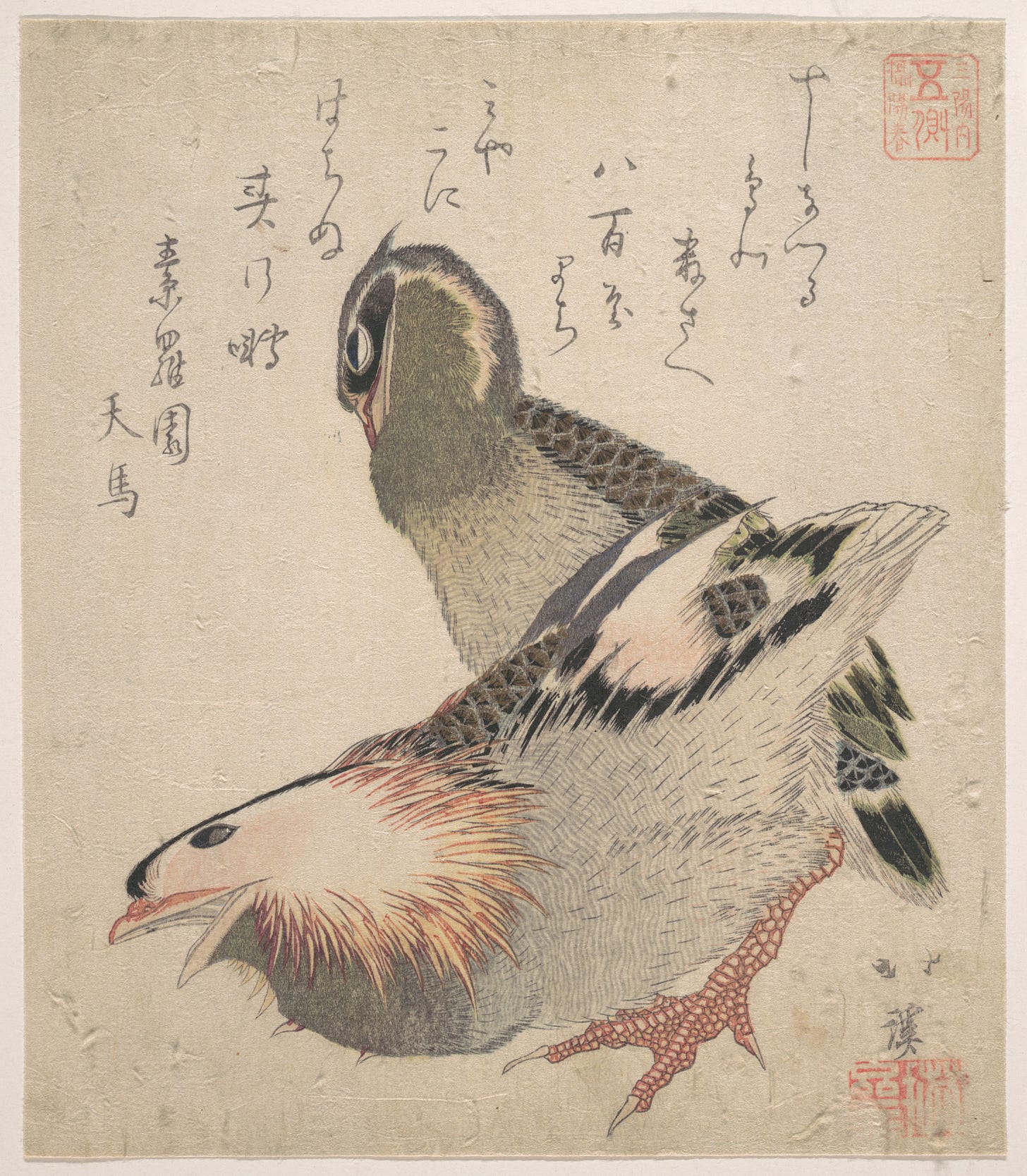
Two Birds, One Eats, One Watches
On the grammar of a self that watches itself watching
There is an idea that keeps surfacing in the texts I read, across centuries and different corners of the world: a self divided into one that acts and one that observes. The Mundaka Upanishad, an ancient Hindu philosophical text1, expresses it through an image — two birds sit in the same tree. One eats the fruit. The other watches the one who eats.
Charles Hallisey introduced me to this image in a seminar called Buddhist Stories: Narrative, Narrative Ethics, and Moral Anthropology, a Buddhism course I took at Harvard Divinity School.
That a Buddhist scholar teaches from a Hindu text might seem odd — but it points to something scholars of religion know: the borders between Hinduism and Buddhism are far less clean than we imagine. The Upanishads predate Buddhism by centuries and shaped Buddhist philosophy so deeply that Buddhist scholars read them as part of their own lineage, even as Buddhism rejected certain Hindu metaphysics.
Not to mention: neither is organized around a monotheistic creator-god. That absence shapes everything — how they’re structured, what counts as knowledge, what the practices are trying to do.
After class one day I wrote it down on an index card. It’s still taped beside my desk, in sharpie, in handwriting only really legible to me.
Two birds sit on a tree. One eats, the other watches.
I can’t remember now whether the reading was Hallisey’s or mine, or my reading built on his. But I have a precise definition of what the two birds mean — at least, what they mean to me: two birds, but the same self. The actor and the one who sees the acting. My professor knew this image in his bones, and now I do too.
And once you see it, it won’t leave you alone. In Buddhist practice, it’s attention observing attention. In Stoic philosophy, it’s judgment watching judgment. In Advaita Vedanta, it’s the witness witnessing itself. In psychoanalysis, it’s self meeting self.
A self that does. A self that watches the doing.
I thought the rhyme meant universalism — same answer everywhere. But the rhyme is just the structure. Everything else diverges: what each tradition diagnoses as the problem, what it tells you to do. The universalism broke.
Let’s imagine you’re the bird.
Replace the birds with your two selves: the one eating, the one observing. To make it concrete, imagine you are eating a peach.
Juice runs down your wrist. You taste the sweetness, feel the skin give under your teeth. Your phone buzzes in your pocket.
Your boss. You know it’s your boss. You skipped work today. Didn’t call. Didn’t text. Just decided you didn’t want to be there — and instead you’re here, eating a peach. I don’t care how fastidious you are, how carefully you organize your life. Instead you are here. You are playing hookey. You are eating a peach. And it feels good.
You instinctively reach toward your pocket, but then you look at your hands: sticky, dripping. You couldn’t answer the phone even if you wanted to.
Now you notice: the clerk is watching you. A child tugs their mother’s sleeve: Mom, why is that person eating it from the pile? 🍑
And then — as you look down at your hands, at the pit in your palm — you realize. This is your fifth peach. You’ve been eating them one by one, straight from the display rack at Whole Foods, while your boss called, while you ditched work, while a child watches and learns that some people just... take what they want.
In a split second, a gorgeous peach turned into a sticky, watched, caught situation. And at the same time, something in you steps back and observes: there I am.
Now what do you do with that watching part?
Watch how the traditions diverge.
1. Buddhist Practice (Early Buddhist Teaching)
One afternoon, a man named Siddhartha sat under a Bodhi tree and gave up the extreme ascetic path. That’s the crux — he stopped striving.
Before that: six years of brutal asceticism. He starved himself to the edge of death. In his own words: "my ribs jutted out, gaunt like the crazy rafters of an old roofless barn."2 According to the texts, this season of his life included: going naked, eating once every few days, only roots and leaves, plucking out hair and beard, continuous standing or squatting, sleeping on thorns or a bare plank, exposure to extreme cold and heat, letting dirt cake the body. He’d nearly died of it. And before that, depending on the tradition, countless lifetimes of moral cultivation had moved him toward this moment, including as a deer and hare.
But then something shifted. According to the story, a woman named Sujātā offered him milk-rice. He accepted. His body recovered. And then he sat under the Bodhi tree, nourished and done with the self-torture.
In that simple observing—the bird watching the bird eat—he grasped the insight beneath everything he’d later teach: Everything changes. Nothing stays permanent. And the suffering comes from clinging to what’s passing. A breath comes in, a breath goes out. A thought arises, a thought dissolves. A sensation appears, a sensation fades.
This maps onto what he’d teach years later as the two arrows: the first arrow is what happens (death, loss, impermanence); the second arrow is what we add when we can’t accept it (protection, denial, striving for perfection).3
What’s particularly interesting is how this relates to Siddhartha’s own journey.
The tradition tells that his mother died seven days after his birth.4 According to the story, a seer had foretold at his birth that he would become either a great king or a great renunciant. His father, wanting an heir, built a palace and raised his son inside it — no sickness, no age, no death, no grief. Just beauty and pleasure and the illusion of permanence.
When Siddhartha finally left that palace, he encountered all the things his father had sheltered him from — and it shattered him.
Instead of accepting the suffering that’s part and parcel of being human, he ran to the forest and tortured himself for six years, convinced that if he was pure enough, disciplined enough, perfect enough, he could transcend it all.
You can read his whole story this way: two refusals of what is. His father trying to protect him from impermanence. He himself trying to perfect his way out of it. Both adding suffering on top of suffering.
Now let’s zoom back in on you: peach juice dripping down your chin in the fluorescent overhead lights of Whole Foods. The present just is — your boss is calling, the kid is staring, you need to do something about the five peaches you just ate. But this moment will pass, and then a new one will arise. And in that moment, you have a sort of freedom. You don’t have to continue to feel guilty or strange or ashamed. You can wipe your face, pay the cashier, and walk outside. Feel the warmth of the sun on your face and take a deep breath.
But here’s the truth: The Buddha sat under a tree with nowhere to be — because he’d left his wife and young son behind in the palace. You’re standing in a grocery store with a boss who can reach you anywhere — with work to pay the bills, obligations to family and friends, practical demands.
The boundaries the Buddha described likely don’t exist in your life. Your mental space gets colonized by other people’s needs.
So can you even find that freedom?
Yes. But it’s smaller than you’d want. It’s not not feeling the eyes on you in the grocery store. That’s real. You can’t control your boss — that’s the first arrow. But the story you spin about it, the loop that keeps you up all night saying I’m going to lose everything — that’s the second arrow. And you can notice the difference. If you pay attention, you can start to notice the difference.
That’s the freedom that the Buddha found under the Bodhi tree that’s available to us today.
2. Stoic Philosophy (Hellenistic Greek Philosophy)
Imagine you lose your job tomorrow. Or your house. Or your health. The Stoics were born into a world where that was the ordinary texture of life — the old self-governing Greek city had been swallowed by distant empires, and fortune (the Greeks called her Tyche, the Romans Fortuna) lifted you and dropped you for no reason. War, exile, plague, slavery: your body, your property, your name were all on loan, and could be called in without notice. So the Stoics asked a brutal question: If everything external can be taken, what is actually mine?
Consider the man who answered it most sharply. Epictetus was born a slave around 55 CE, owned by Epaphroditus — himself a former slave who had risen to administer Nero’s court. A slave of a freedman, at the heart of imperial power, with no say over anything that happened to his body. And he was lame. The tradition tells how: his master, in a temper, was twisting his leg. Epictetus said, calmly, “You will break it.” The master kept twisting. The leg broke. “Did I not tell you?” he said — and that was all. No rage, no collapse. The man with the least control over his external life became philosophy’s great teacher of inner freedom. (He wrote nothing himself; a student, Arrian, wrote it all down.)
What the broken leg taught is what he would teach: the event is not up to you — your judgment of it is. It is not things that disturb people, he said, but their judgements concerning them.5 A judgment arises — external (the clerk’s glare, the child’s question, your boss calling) or internal (the shame you feel about what you’ve done) — but you don’t have to agree with it. You can step back and refuse it. That refusal is a choice, and in that choice is a freedom no master can break. (This echoes what Viktor Frankl would discover in a Nazi concentration camp6: the circumstance is beyond you; your stance toward it is not.)
Now back to the peach. Is the Stoic move always right? You’re covered in peach juice, playing hookey, going against the norms of grocery shopping. Maybe that judgment of shame is telling you something real — about honesty to your boss, about how to behave in shared spaces. That judgment might be useful.
But then the clerk says: “You’re an awful person. What a low life.” That’s different. That’s not a judgment about your action. That’s a judgment about your worth. And that’s the judgment Epictetus refused. That’s when the Stoic move matters most — not to escape all discomfort, but to refuse the verdict that your circumstances or your mistakes prove you’re worthless. That’s where the freedom is.
3. Advaita Vedanta (Hindu Vedantic Philosophy)
The two birds from the start of this essay come from here — the oldest layer of Indian thought. Long before the Buddha, wandering forest sages called the ṛṣis asked a strange question: What is the self behind the eye that sees, the ear that hears — the seer that is never itself seen? They called it the witness, the sākṣin.7
Then the Buddha — the one you just met — came centuries later and pushed back: there is no permanent self at all. The Vedic ritualists said no: liberation must be earned through correct action. That disagreement didn’t resolve. It ran for more than a thousand years.
Two things were happening at once. A genuine theological disagreement: the ritualists believed that correct action, performed rightly, could transform you. Buddhism said that belief itself was part of the delusion. Real philosophical stakes.
But something else was also happening — something we see repeat across institutions and generations: when a new framework threatens authority, resistance hardens. The Vedic ritualists weren’t just defending ideas; they were defending institutional power. And when your entire identity and authority rests on “we’ve always done it this way,” you can’t easily step outside that to ask whether the new framework might be true.
Until, in the 8th century, a monk named Shankara walked the length of India8 — debating philosophers in the courts of kings, founding monasteries, systematizing the scattered teachings of the Upanishads into a single coherent answer. The tradition says he died at thirty-two, but by then he had transformed Indian philosophy by going back to those ancient sages and answering the Buddha the only way he could: What is the self behind the seeing, behind the hearing — the seer that is never itself seen?
His answer: You are the awareness in which seeing and hearing both appear.
That might sound like a riddle. So let’s go back to the produce aisle. Imagine Shankara eating a peach next to you. He’d notice something: Right now, a peach is being tasted. Sweetness is appearing. A judgment is arising. But who or what is aware of all this?
You’ve been taught your whole life that there’s a separate “you” inside, observing the world from a distance. But Shankara would say: look more carefully. You are not the eater, and you are not a watcher standing apart from the eating. You are the awareness in which the eating appears — the awareness in which the sweetness and the judgment both appear. You are the tree, not the birds. The one thing that doesn’t change while everything in it does.
The illusion isn’t the peach. The illusion is the sense of a separate self experiencing it — as if you were outside looking in. You were never outside. The two birds were never two. You are the witness all along.
What was Shankara actually doing with this question? He was dismantling the fixed view of how things have to be. In his time: “This is the correct ritual. This is what a Brahmin does. This is the only path to liberation.” Today: “This is how you buy a peach — plastic bag, scan, card, automatic doors. This is what work is — five days a week, forty years, between these hours.”
But if you see through the illusion of a separate self, then these fixed views also become visible as constructed, not inevitable. You still participate in them — you still pay the cashier, still work — but you’re no longer trapped by the belief that this is who you are or what you must be. That’s where the freedom is.
4. Psychoanalysis (Freudian/Psychoanalytic Psychology)
Fin-de-siècle Vienna was a city of perfect surfaces. In the salons, in the parlors, in the theaters — everyone performing propriety, hiding desire, maintaining decorum. It was the world’s masterclass in repression.
Into Freud’s consulting room at Berggasse 19 come patients with “hysteria”: a paralyzed arm, sudden blindness, a cough that no doctor can explain. The body is speaking what the mind refuses to know.
His discovery: you really are divided — but not into two tidy birds. Freud saw at least three parts at war. There’s the part that wants — he called it the id — the hunger, the impulse, the one that reached for the fifth peach. There’s the part that judges — the superego — the internalized voice of your parents and your culture: you’re making a mess. And there’s you in the middle — the ego — trying to keep the peace between them.
Freud used an image for this: the ego is like a rider on a horse. The id is the horse — raw, powerful, wanting to run where it wants. You are the rider, trying to hold it in check. But behind you rides the superego, the voice of every authority you ever swallowed, screaming: rein it in, you’re making a mess. So you haul back hard on the reins and force the horse down into the unconscious. But a horse held down doesn’t disappear. It just gets angrier. The more you push it down, the more it bucks, erupts as symptom: the paralyzed arm, the cough, the body saying what the mind won’t.
Now, two years later, you’re on Freud’s couch. There’s a bowl of fruit on the table beside you. The word surfaces on its own: peach. Free association takes over.
“Peach... the juice... the softness... my mother, actually, feeding me fruit when I was small... her hands were always clean, mine were always sticky... she’d wipe my mouth and say, ‘You’re making a mess.’ The stickiness. The mess. The wanting more when I should want less. Skipping work. Not answering the phone. Taking what I want. The fifth one, the —”
And Freud says nothing. He just writes. Because it’s all there — not just the hunger, but the whole rebellion. The impulse to skip work, to ignore authority, to take without asking, to make a mess. All of it pushed down. All of it returning.
Integration isn’t crushing the horse or pretending to master it. It’s seeing clearly what’s happening: you are the rider on a horse you don’t control. Freud’s own image: “Often a rider, if he is not to be parted from his horse, is obliged to guide it where it wants to go.”9 The ego thinks it’s choosing. It’s actually obliged to go where the id wants, calling the horse’s will its own.
But here’s what changes with consciousness: you stop pretending. You stop the blind repression that makes the horse buck as symptom. Your adult ego sees what’s been fighting underground — the hunger, the rebellion, the mess — and you stop lying about who’s really riding. You can work with the horse instead of against it. Satisfy it, sublimate it, understand why you needed to deny it. The point isn’t freedom from the horse. It’s honesty about the ride.
The Bird That Eats Too
Four traditions, four moves. You could release the grip like the Buddhist says. Refuse the verdict like the Stoic. Recognize you’re the tree like Shankara. Be honest about the ride like Freud.
So what I thought was the same thing turned out to be four different responses to the same structure. The rhyme is real, but the divergence is where the tradition’s specific wisdom lies. I went looking for one answer and found four. That’s not failure — that’s the grammar of meaning making.
But follow any of them far enough down, sit with the watching long enough, and something breaks open.
Hallisey used to describe it like this: there’s a bird watching a bird eat. But then there’s another bird watching that bird watch. And another watching that. Infinite mirrors is how I imagined it; each layer you thought was solid ground turns out to be another fold of watching, with no floor underneath. It’s what Hofstadter calls a Strange Loop10: the system observing itself observing itself, with no way out.
For a long time I thought this was the breakdown, like stepping into quicksand. The more you negate, the deeper you sink. But at divinity school, I learned a different word for this: apophatic. Wisdom arriving through negation, not affirmation.
You can’t define the watcher because the watcher keeps becoming something to be watched. The path isn’t “here is the answer.” It’s “strip away, again and again, what you’re not.”
The Buddhist strips away the permanent self (anatta, nothing to cling to). The Stoic strips away control over externals (only your judgment is yours). The Vedantin strips away both watcher and eater (neti, neti, not this, not this11). The psychoanalyst strips away the rider (you’re not in control of the ride).
Four traditions, four negations. Each strips away a different false ground. Each one leaves a different space to move in. And the wisdom isn’t choosing one forever. It’s discernment — knowing which move is skillful when. When to release, when to refuse, when to recognize, when to be honest.
And sometimes, it’s just eating a delicious peach.
The Mundaka Upanishad, an ancient Hindu philosophical text, is one of the principal Upanishads, ancient Sanskrit philosophical texts that form the concluding portions of the Vedas. Scholars date it somewhere between 800 and 200 BCE, though the exact composition date is uncertain. The two-birds image appears at Mundaka 3.1.1 and recurs at Shvetashvatara 4.6. The image is older still: the Mundaka quotes it almost verbatim from Rig Veda 1.164.20, the “riddle hymn” of the sage Dīrghatamas (~1500–1200 BCE). For public-domain translations, see Max Müller’s Sacred Books of the East, Vol. XV (free at archive.org) or Robert Ernest Hume’s The Thirteen Principal Upanishads (Internet Archive).
The quote is from the Mahāsaccaka Sutta (Majjhima Nikāya 36), translated by Bhikkhu Ñāṇamoli and Bhikkhu Bodhi in The Middle Length Discourses of the Buddha (Wisdom Publications, 1995). The full passage reads: “my ribs jutted out, gaunt like the crazy rafters of an old roofless barn.”
The teaching of the two arrows (or two darts) comes from the Sallatha Sutta (Samyutta Nikaya 36.6), where the Buddha explains that when a painful sensation arises (the first arrow), we compound it with mental resistance, aversion, and the story we tell ourselves about it (the second arrow). The first arrow is inevitable; the second arrow is optional. Free translation available at SuttaCentral.net/sn36.6.
According to the traditional biographies, the Buddha’s mother, Queen Māyādevī, died seven days after his birth. The seer’s prophecy and the sheltered palace are recorded in the Nidānakathā (the Jātaka introduction) and Aśvaghoṣa’s Buddhacarita (1st–2nd century CE). The Buddha’s own account of his sheltered upbringing appears in the Sukhumāla Sutta (Aṅguttara Nikāya 3.38). His wife was Yaśodharā and his son was Rāhula.
Epictetus, Enchiridion (Handbook) §5. For a public-domain translation, see Elizabeth Carter’s 1758 rendering (Project Gutenberg) or the MIT Internet Classics Archive. For a modern translation with commentary, see Robert Dobbin’s Epictetus: A Stoic and Socratic Guide to Life (Penguin Classics).
Viktor Frankl, Man’s Search for Meaning (1946). Frankl, a Viennese psychiatrist, survived three concentration camps (Theresienstadt, Auschwitz, Dachau) and wrote this slim, shattering book about his experience. His central insight — that even in the camps, prisoners retained “the last of human freedoms,” the ability to choose their attitude toward their circumstances — is the Stoic insight arriving independently in the worst imaginable conditions.
Sākṣin (Sanskrit, “the witness”) is, in the Advaita Vedānta tradition, witness-consciousness — the awareness in which experience appears without itself becoming any of the things it observes. The question of the unseen seer appears in the Bṛhadāraṇyaka Upanishad 3.4.2. Advaita holds that this witness is not a capacity one develops but one’s true nature, uncovered rather than achieved through the method of neti, neti (”not this, not this”).
Shankara (traditional dates 788–820 CE, though some scholars place him ~700 CE) was an Advaita Vedānta philosopher who walked the length of India debating other philosophers, founded four major monasteries, and systematized Advaita philosophy through his commentaries (bhāṣya) on the Upanishads, Brahma-sūtra, and Bhagavad Gītā. The tradition says he died at thirty-two. For an accessible introduction, see the Stanford Encyclopedia of Philosophy entry on “Śaṅkara.”
Sigmund Freud, The Ego and the Id (1923), Standard Edition of the Complete Psychological Works of Sigmund Freud, Vol. 19. The quote appears in Chapter II. Freud’s horse-and-rider metaphor illustrates the ego’s apparent control over the id: the rider (ego) thinks it directs the horse (id), but in reality the ego is often obliged to guide the horse where it wants to go, then rationalize the movement as its own choice.
Hallisey introduced the two-birds image; the infinite-regress/infinite-mirrors extension is my own. Douglas Hofstadter, I Am a Strange Loop (Basic Books, 2007). A Strange Loop is a self-referential system that loops back on itself — consciousness observing consciousness observing consciousness. Hofstadter argues this infinite recursion is what creates the feeling of “I,” of self-awareness.
neti neti (”not this, not this”) appears in the Bṛhadāraṇyaka Upanishad 2.3.6 (also 4.5.15 and 3.9.26). This is the primary method of Advaita Vedānta: negating false identifications with body, mind, and ego to arrive at the witnessing consciousness. For public-domain translations, see Max Müller’s or Robert Hume’s editions of the Upanishads.