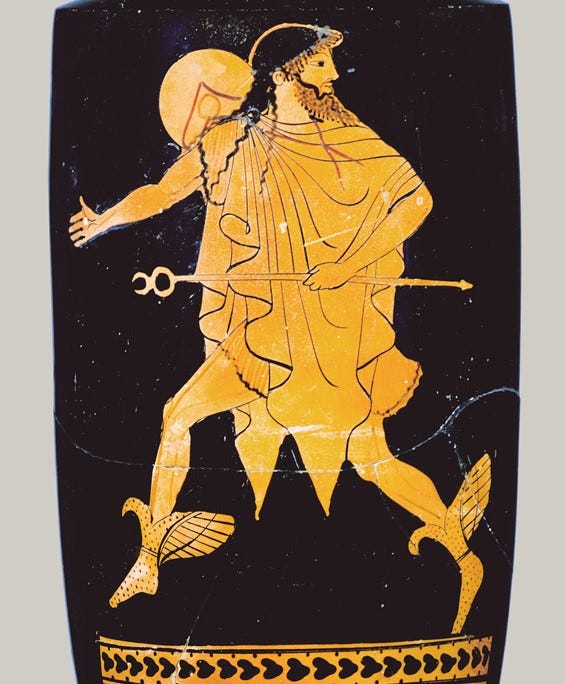
The God at the Threshold
The study of interpretation is named for the god who crosses into death and comes back — because meaning isn't found on the lit surface. It's made by crossing into what isn't yours.
In the Odyssey‘s final scene, Odysseus comes home. For ten years he has been lost on the way home from a ten-year war, presumed dead. In his absence, suitors have surrounded his wife, Penelope, each demanding she choose one to marry. Now, in the great hall, he kills them all. Their slaughtered bodies lie on the floor.
In comes Hermes — the god who guides souls to the underworld. He lifts his golden wand and wakes them. According to Homer, they gibber like bats, a cluster coming loose all at once, flittering and squeaking into the dark. They follow Hermes past the White Rock, past the gates of the Sun and the land of dreams, to the meadow of asphodel where the dead live.1
Hermes is the only god who makes that crossing and comes back. He leads the newly dead down, and Persephone back up each spring. The Greeks called him psychopomp, the soul-guide — and notice what that meant to them: when they pictured the last boundary a person crosses, they did not station a judge there. They sent a guide.
In Greek mythology, the cosmos was divided by lot among three brothers: Zeus drew the bright sky, Poseidon the sea, and Hades the realm of the dead.2 The other gods keep their distance from death. When Hippolytus — the young hunter who worshipped Artemis above all — lies dying, the goddess who loved him comes to his side, and then must leave him: it is not lawful, she says, for me to look upon the dead, or let death’s breath stain my eye.3 Even a goddess who loves you cannot stay to watch you die.
But Hermes is not afraid of the underworld — perhaps because he is in-between by birth — the highest god for a father, a rustic mountain nymph for a mother, born not on Olympus but in a cave, the youngest and least settled of the gods, an outsider among them. He’s also in-between by trade: the messenger, the one who carries words between gods and mortals. In short, he lives in the doorway.
I keep returning to that descent, and I’ve come to think it’s the most important thing about him. The study of meaning is named for him — hermeneutics carries a god in it. (The strict philology is debated: scholars argue whether hermēneuein, “to interpret,” descends from Hermes or only leans against him by accident of sound.4)
Two words, and the difference is the whole point. Interpretation is the act — the work of asking what something means. Meaning is the goal — what gets made when the asking lands. Hermeneutics is the theory of the act; this project is a hunt for what it makes. And the god of the act is the one willing to go down.
Which is what interpreting actually is. You do not make meaning in the light, with what is already plain and already yours. You make it by crossing into what isn’t — the depths of a text, the past that built it, the unsaid, the unfamiliar, the stranger, the dark of another mind. Meaning is made at the edge of what you know, by going past it into what you don’t, and carrying something back. Meaning that never leaves the familiar is only half a meaning. (Buber: all real living is meeting.5 Freud: the meeting that matters most is with the underworld of a mind.6)
I learned the word hermeneutics the way you learn you’ve been doing a thing all along without its name. I raised my hand in a seminar and asked what it meant — it had been circling the room for twenty minutes, and everyone seemed to know but me. The art of working out what something means, the professor said, and moved on.
It took the walk home to feel the joke. That is exactly what I had just done — raised my hand and tried to work out what something meant. I had performed hermeneutics in order to ask for the word hermeneutics. The thing had been in my mouth the whole time; I only lacked its name. I’d been standing in the doorway, asking the way to the door.
To interpret, then, is to stand at the herm — the boundary-stone the Greeks set in every doorway and at every fork in the road. The anthropologists have their own word for that place: liminal, from limen, threshold, where (Turner said) you are unmade and remade in the crossing itself.7
Which makes this project — the Grammar of Meaning — hermetic by its own etymology. Each of these traditions is already such a crossing: each takes the raw stuff of a life — the loss, the love, the dying — and carries it into meaning. To read them against one another is not to stand on one bank, looking at the next. It is to stand where all their crossings meet, and ask what they are doing when they make meaning at all — a threshold between thresholds. The study of how meaning gets made lives in no single tradition. It lives only in the doorway between them.
Homer’s dead followed Hermes into the dark, gibbering like bats. Ever since I raised my hand in that seminar, I have been following him too.
Homer, Odyssey, Book 24 — Hermes rousing the suitors’ souls, who follow him “like bats” past the White Rock, the gates of the Sun, and the land of dreams to the asphodel meadow. Public-domain translations: Samuel Butler (1900) or A.T. Murray (Loeb, 1919), both free at the Perseus Digital Library.
Homer, Iliad, Book 15 — Poseidon recalls the cosmos divided by lot among the three brothers: Zeus the sky, Poseidon the sea, Hades the dark below; earth and Olympus held in common.
Euripides, Hippolytus — Artemis must leave the dying Hippolytus, since the gods may not look on death. (The line here renders her sense; it is not a verbatim quotation of any single translation.)
The Hermes → hermeneutics link is an ancient association, not a settled derivation. Greek tradition long tied Hermes to interpretation and language (hermēneus, “interpreter”), but modern linguists regard the kinship as uncertain — hermēneus may be pre-Greek or of independent origin. Offered here as resonance, not philology.
Martin Buber, I and Thou (1923) — “all real living is meeting.”
Sigmund Freud, The Interpretation of Dreams (1900) — the method of reading downward into the unconscious. (”The underworld of a mind” is my phrase, not Freud’s.)
Arnold van Gennep, The Rites of Passage (1909), and Victor Turner, The Ritual Process (1969) — the “betwixt-and-between” of the liminal phase, where transformation happens on the threshold, not after it.