Socrates Hated Writing. We Know Because Plato Wrote It Down.
“This discovery of yours will create forgetfulness in the learners’ souls, because they will not use their memories… they will appear to be omniscient and will generally know nothing; they will be tiresome company, having the show of wisdom without the reality.”
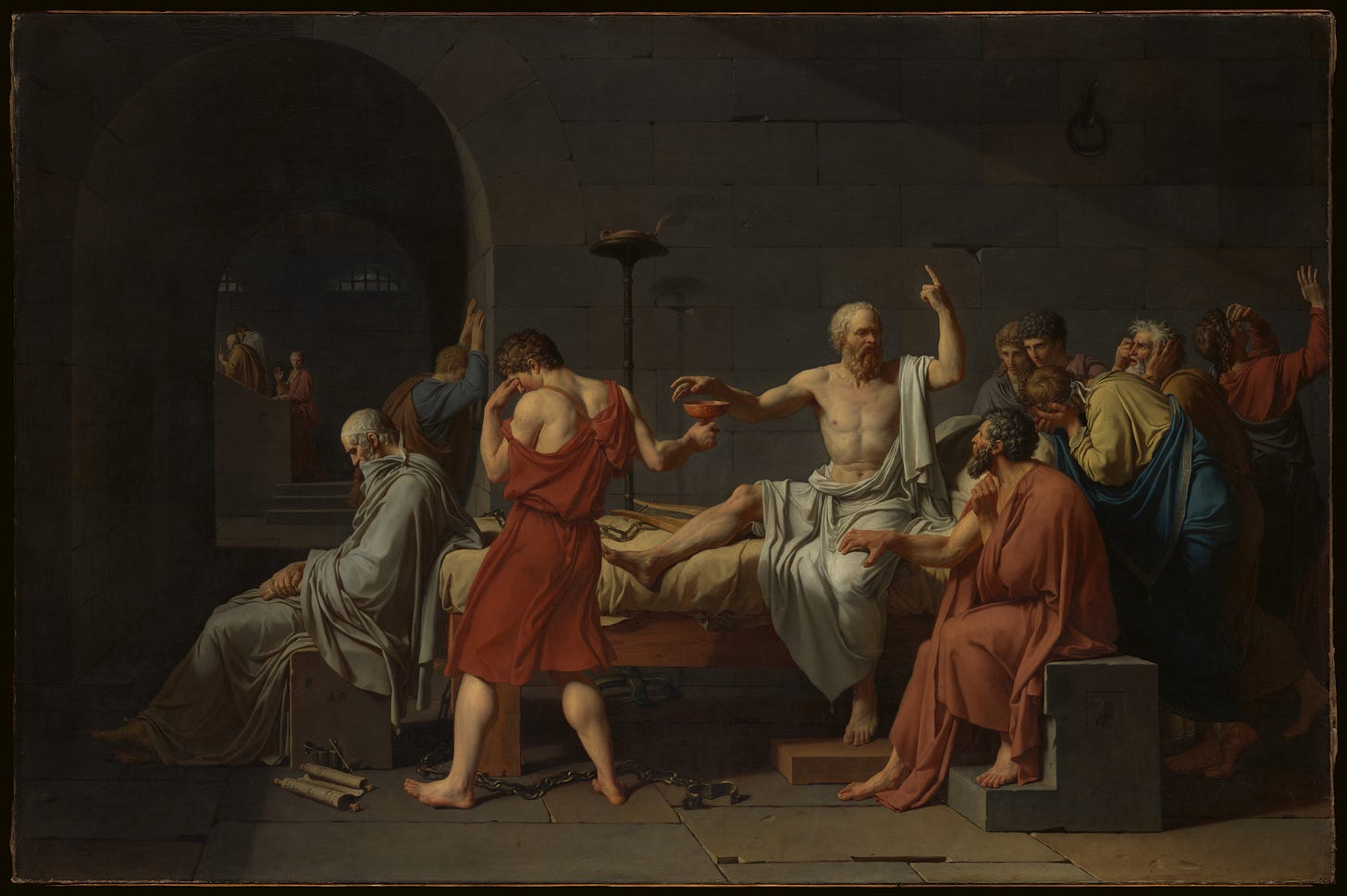
“This discovery of yours will create forgetfulness in the learners’ souls, because they will not use their memories… they will appear to be omniscient and will generally know nothing; they will be tiresome company, having the show of wisdom without the reality.”
— King Thamus, refusing the gift of writing, in Plato's Phaedrus (~370 BCE)
It’s strange to think Socrates would be horrified that I’m writing this.
Socrates was Athens' most famous talker. He spent his life in conversation — in the agora, in doorways, at dinner parties — asking questions until people realized they didn't know what they thought they knew.
He left no writings, and this was a deliberate choice. The world he moved in — Athens' educated class, the philosophers and rhetoricians — was going literate; writing was becoming the way serious people held serious thoughts. He declined anyway.
Everything we have of him comes from his students, above all from Plato — who, after Socrates' death, wrote him as the main character in a series of philosophical dialogues, essentially plays of ideas. So almost the only reason we know what Socrates thought is because Plato did the thing Socrates distrusted. The irony is structural, before we even get to the story.
His distrust had two edges. The first was memory: writing won’t strengthen it, it will replace it. The second was sharper — a book can’t answer back. His whole method was live questioning, pressing until contradictions surfaced. A text just sits there, saying the same thing forever, to anyone who picks it up. Socrates couldn’t work with that.
In Phaedrus, Plato gives voice to Socrates' concern the way a careful thinker makes a difficult point: through someone else. In this case, it's King Thamus. One day, the Egyptian god Theuth — ibis-headed, inventor of letters — brings writing to King Thamus as a gift for memory and wisdom. Thamus refuses it. Writing, the king says, won't strengthen memory — it will replace it. People will stop holding things and start looking them up, and mistake the looking-up for knowing: "This discovery of yours will create forgetfulness in the learners' souls, because they will not use their memories… they will appear to be omniscient and will generally know nothing; they will be tiresome company, having the show of wisdom without the reality."1
The layering is worth holding still a moment. Plato writes Socrates, who tells a myth, in which Thamus voices the fear. Thamus is not quite Socrates. But he is Socrates’ concern, wearing a crown.
Why the distance? Why not just say it directly? Was Plato protecting himself — a student still living in the shadow of a teacher the city had killed? Or was it something harder to admit: that he couldn’t quite own, in his own voice, an argument his own act of writing undermined?
It’s exactly the kind of question Socrates would have asked — if he’d lived to read it.
He wasn’t wrong about the trade. Writing did cost us the bards who carried whole epics in the body, the trained memory an oral world simply required — mostly gone now. It wasn’t only the Greeks who felt that loss: early Muslims resisted writing down the hadith for generations, partly for the same reason — oral transmission felt more alive, more trustworthy, harder to corrupt. The chain of named transmitters was the guarantee.2
And writing gave us something too. That’s why we know about Socrates. Every idea that survived its thinker is largely due to the invention of writing.
Socrates had a word for it: pharmakon — much like we use “double-edged sword” today.3 Remedy and poison, the same vial. His position was never ban it — it was narrower and harder than that. Writing is a fine reminder for someone who already understands. A dangerous substitute for understanding itself. He held that position to the end.
He wrote nothing.
Thamus refused the gift. Plato recorded the refusal — in writing. On Socrates’ behalf.
Fast forward twenty-four centuries.
Thamus’ objection is, very nearly word for word, the worry about AI today. As it was the worry about Google. As it was the worry about the pocket calculator. Each time, the fear underneath is the same: that we’ll hand something essentially human over to a tool — memory, calculation, reasoning — and lose it. Now the fear has inverted too: not that we’ll stop remembering, but that we’ll stop reading.
So before settling whether the machines are making us stupid, a smaller question, and a better one: what does it give, and what does it take? Every tool that changes how we know does both.
Plato, Phaedrus 275a–b, trans. Benjamin Jowett (1871, public domain). The full Theuth–Thamus myth runs 274c–275b. Free text: Project Gutenberg. ↩
On the hadith and oral transmission: Jonathan A.C. Brown, Hadith: Muhammad’s Legacy in the Medieval and Modern World (2009). The major written collections — Sahih al-Bukhari (d. 870), Sahih Muslim (d. 875) — date to the 9th century, roughly two centuries after Muhammad’s death (632 CE). ↩
Pharmakon appears at Phaedrus 274e, where Theuth presents writing as a remedy for memory. The remedy-and-poison double meaning is drawn out by Jacques Derrida in “Plato’s Pharmacy,” in Dissemination (1972; Eng. trans. 1981). ↩